Retail accountability · SGARs
“200x less toxic” does not mean safe
Several dangerous rat poisons were marked for clearance. Beside them, another SGAR was being promoted with a large, reassuring claim. The shelf may be changing—but the threat to animals has not disappeared.

This month, we photographed a striking display in a major supermarket. Several second-generation anticoagulant rodenticides—often shortened to SGARs—were marked “Clearance”. Nearby, No Mice Difend products were being discounted and promoted beneath a large yellow sign.
The dominant message was simple: “200X less toxic to dogs.”
The much smaller words underneath said the comparison was with “full-strength brodifacoum rodent baits”. That context changes how the headline should be understood. The product is not being compared with something harmless. It is being compared with another powerful SGAR.
“Less toxic than another poison” is not the same as safe.
What we found on the shelf
At the same supermarket, at the same time, we saw Ratsak Fast Action Throw Packs, Ratsak Fast Action Wax Blocks and Talon Pellet Trays marked for clearance. The No Mice Difend range remained prominently displayed, with its prefilled bait station discounted by 30% and supported by the large safety-oriented promotion.
The photographs establish that the aisle was changing. They do not, by themselves, prove why the retailer chose to discount or discontinue particular lines. Clearance pricing can reflect regulation, stock replacement, supplier decisions or ordinary retail changes. We should not claim a cause that the evidence does not establish.


Multiple SGAR products were being cleared or discounted in the same aisle. They do not prove that the APVMA rules caused each markdown. We have asked for clarity rather than filling that gap with an assumption.
A reassuring number can hide a much bigger problem
No Mice Difend contains difenacoum, a second-generation anticoagulant rodenticide. Like other anticoagulant poisons, it interferes with the body’s ability to clot blood.
The supermarket claim focuses on one comparison involving dogs. It does not tell shoppers the whole story: whether lower exposures can cause serious illness, how repeated exposure matters, how residues can remain in animal tissue, or what happens when wildlife eat poisoned rodents.
LD50 is an estimate of the dose that kills half of a test group under specific conditions. A lower number generally means greater acute toxicity. But LD50 is not a safety limit and it does not measure every form of harm, every species, repeated exposure or movement through the food chain.
Whatever calculation sits behind “200x less toxic”, it is still a comparison between two poisons. A product can be less acutely toxic than brodifacoum and still present serious risks to dogs, wildlife and other animals.
Predators do not need to touch the bait
When a rodent eats an SGAR, the poison does not necessarily remain inside the bait station. The rodent can carry it into the wider environment before becoming visibly ill or dying.
An owl, eagle, quoll, goanna or other predator can then be exposed by eating that contaminated animal. Scavengers may be exposed in the same way. This is called secondary poisoning.
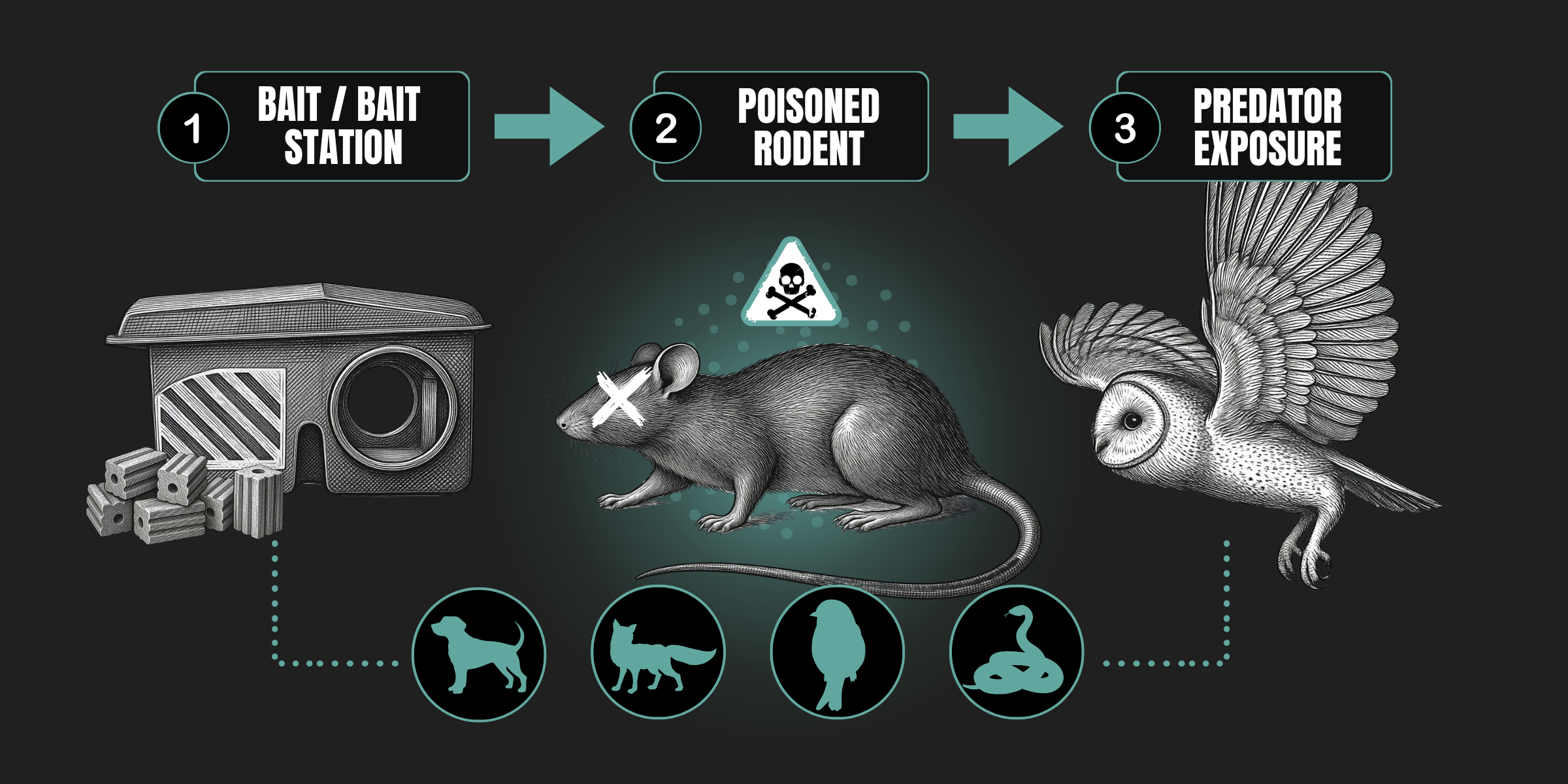
That is why securing bait inside a station can reduce direct access without eliminating the broader ecological pathway. The animal that consumes the bait can still leave the station.
The products were suspended—then some suspensions were lifted
The supermarket display appeared during a major period of regulatory change.
Lifting a suspension does not mean the active poison has become harmless. It means the regulator accepted revised controls for those particular registrations. The products remain SGARs, and the risks associated with poisoned animals moving through the food chain remain relevant.
Revised conditions are not the same as removing the poison.
Did the new rules cause the clearance sales?
We cannot say that with certainty.
The timing and the mix of products are consistent with a changing regulatory and retail environment. Some stock may be leaving shelves while products with updated approvals continue. But a clearance label is not evidence of the retailer’s reason.
The APVMA rules also do not automatically require all old-labelled SGAR stock to disappear immediately. Existing Australian stock may continue to be supplied under temporary deemed-permit arrangements. For still-suspended products, the required instructions must be physically provided to the purchaser at the point of sale.
The APVMA has also confirmed that throw packs can still be supplied under those arrangements, provided they are used inside tamper-resistant bait stations. It would therefore be inaccurate to say loose bait is automatically unlawful simply because the bait station is sold separately.
What the current interim rules mean
These are interim supply and use controls—not a retail ban. They change how some products can be sold and used while allowing SGAR stock to remain available.
On-shore products can continue to be supplied under the temporary deemed-permit arrangements.
For still-suspended stock, retailers must physically provide the APVMA’s replacement instructions.
They may still be supplied, but the APVMA says they must be used inside a tamper-resistant station.
The proposed Restricted Chemical Product declaration is separate and is not yet preventing public purchase.
This leaves an important practical question: when still-suspended stock is sold, are shoppers actually being handed the required instructions? That is a concrete compliance issue, unlike speculation about why a retailer chose a clearance price.
Why we reported the promotion
Animal Liberation reported the display because advertising should be judged by the overall impression it creates—not only by whether a qualification appears somewhere in smaller type.
A shopper sees an enormous promise about reduced toxicity to dogs. The comparison with brodifacoum is far less prominent. The promotion does not explain that the product still contains difenacoum, remains an SGAR, or can expose predators and scavengers through poisoned rodents.
On 13 July, the APVMA asked us to provide the photographs supporting our report. That request is not a finding that the company or retailer has breached the law. It does mean the evidence is now before the regulator, and we will continue seeking a clear response.
The problem does not end at the supermarket shelf
Clear retail information matters. Stronger use conditions matter. But neither removes SGARs from council buildings, facilities or contractor-managed sites.
Even if SGARs are eventually classified as Restricted Chemical Products, authorised contractors—including the same kinds of operators councils engage—may still be able to buy and use them. Restricted access is therefore a minimum safeguard, not the end goal.
Councils can make a stronger choice now: remove SGARs from their own contracts and facilities.
Animal Liberation’s NSW Council Tracker brings together the answers we have received from all 128 councils. At the time of publication, 36 were confirmed SGAR users and 55 remained under investigation because we had not received a complete or clear answer.
Animals should not be treated as acceptable collateral damage because they were not the intended target. Every council phase-out closes another pathway through which owls, raptors, reptiles, quolls, companion animals and other wildlife can be exposed.
Check your council
Find your council’s current position. Where SGAR use continues, ask councillors to phase it out. Where the answer is still unknown, help us demand one.
Sources and further reading
Official APVMA regulatory documents
- APVMA Gazette No. 5, 10 March 2026 — SGAR suspension notice, reasons and deemed-permit instructions.
- APVMA Gazette No. 12, 16 June 2026 — No Mice Difend label variations and revocations of suspension.
- APVMA anticoagulant rodenticide FAQs — point-of-sale instructions, old stock, throw packs and RCP implementation.
- APVMA Anticoagulant Rodenticides Review Technical Report — assessment of risks to people and non-target animals.
Take action and follow the campaign
Editorial note: Clearance labels show that products were discounted or being discontinued at that store. They do not establish why the retailer made that decision. Tracker figures should be checked again if publication is delayed, as council statuses change when new correspondence is received.