Important progress has been made. The poisons have not been removed.
In March 2026, Australia’s chemical regulator publicly acknowledged that the way second-generation anticoagulant rodenticides are currently used creates unacceptable risks to animals beyond the intended targets. That finding matters. But headlines about a “suspension” or “restricted” status can make the outcome sound stronger—and simpler—than it is.
Three processes are unfolding at once. The APVMA’s broad chemical review remains underway. It imposed temporary, product-level suspensions while stronger directions were introduced. Separately, the Commonwealth is considering whether SGARs should become Restricted Chemical Products, or RCPs.
The chemical review
Decides which active constituents, products, uses and labels can continue after the APVMA assesses safety, efficacy, trade and labelling.
Interim suspensions
Introduced enforceable conditions quickly from March 2026 while the wider review remains unfinished.
RCP declaration
Would prevent lawful supply to people who are not authorised under the relevant state or territory framework. It would not prohibit every authorised use.
Restriction is progress. It is not elimination. A poisoned rodent remains a route of exposure regardless of who placed the bait.
What are SGARs—and why do they create wider risks?
Second-generation anticoagulant rodenticides are poisons designed to stop blood from clotting. After consuming a lethal dose, a rat or mouse usually dies several days later from uncontrolled internal or external bleeding.
The five SGAR active constituents covered by the restricted-product proposal are:
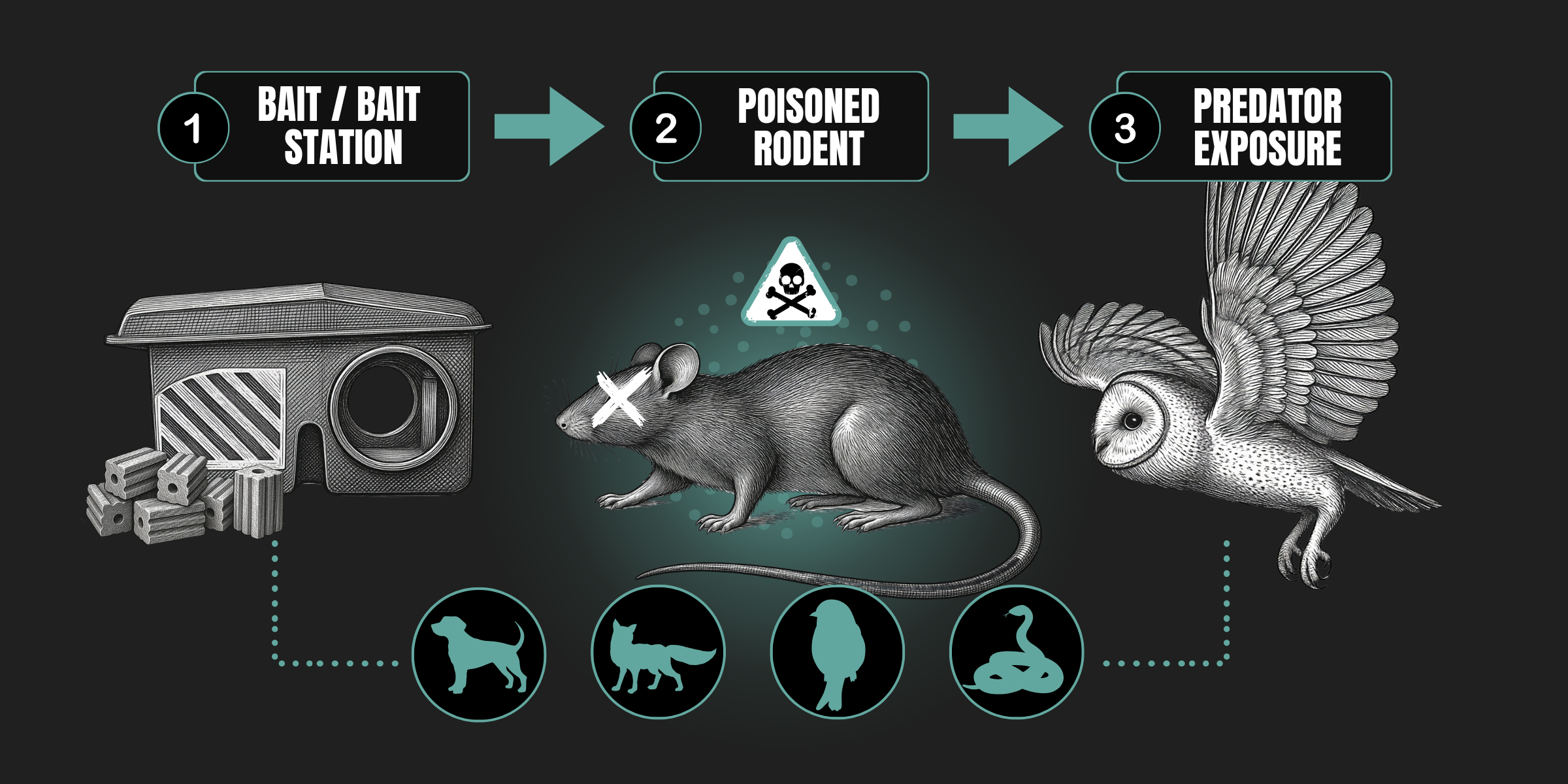
SGARs were developed to deliver a lethal dose in a single feeding and generally break down more slowly than first-generation anticoagulant rodenticides, increasing the opportunity for secondary exposure. A bait station can reduce direct access to the bait, but it does not keep the poison inside the station. A poisoned rodent may move into a garden, park or habitat where an owl, eagle, quoll, goanna or other predator or scavenger eats it.
Why did the APVMA begin the review?
The formal reconsideration began in November 2021 after earlier consultation about how anticoagulant rodenticides were used in Australia. The review covers first- and second-generation products and examines environmental safety, risks to people and workers, residues and trade, product chemistry and whether labels can adequately manage those risks.
The APVMA says it considered more than 1,700 studies and published scientific articles. Its assessments identified risks including primary poisoning from direct bait consumption, secondary poisoning through contaminated animals, accidental exposure of children and risks associated with some products and use patterns.
Poison can move through animal tissue
Predators and scavengers may be exposed after eating contaminated rodents or other animals, even when they never encounter the bait itself.
Existing controls did not prevent all accidental exposure
The technical report says existing mitigation measures were not effectively preventing accidental bait ingestion by children.
Some formulations lack basic safeguards
The APVMA proposed cancelling products without both a marker dye and bittering agent, as well as liquid and powder bait-concentrate products identified in the proposed decision.
Placement and duration expand exposure
Outdoor baiting, burrow baiting, prolonged treatment and inadequate carcass recovery can increase the opportunity for other animals to be poisoned.
The regulatory timeline
The sequence matters because a proposed decision, a temporary suspension and a final regulatory decision do not have the same legal effect.
The APVMA notifies affected product holders and calls for information to support the review.
The APVMA proposes changes to active approvals, product registrations, labels and uses, and proposes cancelling selected products.
The regulator says current SGAR use presents unacceptable risks to non-target animals, including native wildlife.
Consultation on the proposed review decision closed on 16 March. One-year suspensions of all SGAR product registrations began on 24 March with interim instructions; many individual suspensions were later revoked after product changes.
After additional instructions, conditions and—in some domestic products—pack limits are added, the APVMA lifts suspensions for many individual products. Status becomes product-specific.
Feedback will be reviewed to inform the Assistant Minister’s decision.
The APVMA has not published its final chemical-review decision. SGARs have not yet been declared RCPs in Commonwealth regulations.
The department’s published timeline places ministerial consideration—and any resulting regulation amendments—in late 2026 to early 2027.
Where things stand now
The consultation period closed on 16 March 2026. The APVMA says the final decision will be published after it considers the submissions received.
PendingThe APVMA has not published a firm date. It says timing depends on the number and complexity of submissions.
Not announcedThe APVMA has certified that declaration is in the public interest, but the Commonwealth has not yet amended the regulations.
Not in forceThe department’s published timetable places ministerial consideration—and any resulting regulation amendments—in late 2026 to early 2027.
Indicative timetableThe APVMA says there are no new SGAR qualification requirements at this time. Any future training, qualification, licensing or other authorisation requirements would be set through the relevant jurisdictional frameworks.
No change yetStatus now varies by product. Some suspensions have been revoked following label or registration changes. A product whose suspension has not been revoked remains subject to the applicable suspension notice, while proposed cancellations are not final until the review decision is published.
Check productWhat rules apply to SGAR products that remain suspended?
The March suspension introduced enforceable directions for suspended SGAR products. Those directions still matter, but they are no longer a complete description of the rules applying to every product. Numerous suspensions were later revoked after registrations and labels were varied. Current requirements must therefore be checked product by product.
Products that remain suspended are governed by the applicable suspension notice and directions. Products whose suspensions have been revoked operate under their varied approvals. For a product that remains suspended and bears a suspended label, eligible existing stock may only be supplied under the Gazette’s transitional arrangements, including the replacement directions and any applicable pack-size limit.
Indoor use, bait stations and treatment limits
For products governed by the March instructions, domestic use is indoors only, bait must be secured in a tamper-resistant station, and continuous treatment cannot exceed 35 days without further advice.
Tighter controls on outdoor placement
The March instructions prohibit outdoor mouse baiting, require outdoor rat stations to be within two metres of buildings, prohibit direct burrow baiting and require an evaluation after 35 days.
Replacement instructions must be physically provided
For a product that remains suspended and bears a suspended label, eligible existing stock may only be supplied in accordance with the Gazette directions. The purchaser must be physically given the replacement instructions, and any applicable pack-size limit must also be met.
Carcasses, slugs, snails and uneaten bait
The directions require searches for contaminated animals and safe disposal of carcasses and uneaten bait, with disposable gloves used during handling and clean-up.
These controls can reduce some pathways of exposure. They do not make an SGAR harmless, and they do not guarantee that every poisoned animal will be found before a predator or scavenger reaches it.
What does the proposed chemical-review decision seek to change?
The December 2025 decision is still a proposal. The APVMA must consider submissions before publishing the final outcome, and the final conditions may differ. Broadly, the proposal seeks to retain some products only with stronger controls while cancelling products or uses whose risks cannot be adequately managed.
Stronger instructions for where and how bait may be used
Proposed directions address bait-station design, placement, treatment length, monitoring, carcass recovery, disposal and protective equipment.
Smaller packs and mandatory tamper-resistant stations
The technical recommendations include pack-size limits for products available to the public and station-only use for domestic anticoagulant baits.
Use by people meeting relevant requirements
The proposed review would restrict commercial anticoagulant products to people meeting relevant training or authorisation requirements. For SGARs, the separate RCP process would govern who may lawfully receive the products.
Products whose risks cannot be adequately mitigated
The APVMA proposes cancelling selected registrations, including products lacking both a dye and bittering agent and certain concentrate formulations.
What would Restricted Chemical Product status actually do?
An RCP is an inherently hazardous agricultural or veterinary chemical that is subject to strict controls. If SGARs are declared RCPs, they could only lawfully be supplied to people authorised to use them under the relevant state or territory law. Each jurisdiction would determine the training, qualifications, licensing or other requirements for that authorisation.
RCP status would
- remove general, unrestricted access to the covered products once implemented;
- limit lawful supply to people authorised under the relevant state or territory framework;
- require state and territory systems to specify training, qualification, licensing or other authorisation pathways;
- make unauthorised supply contrary to the national RCP framework.
RCP status would not
- ban every SGAR product or end every use;
- prevent an authorised contractor from using SGARs for a council or business;
- remove the secondary-poisoning pathway created by contaminated rodents;
- guarantee identical authorisation rules in every state and territory.
The distinction is central to Animal Liberation’s position. Restricting access recognises that these are not ordinary household products. But an authorisation system regulates who may lawfully receive and use the poison. It does not resolve the underlying harm created when the poison moves through animals and ecosystems.
Why council action still matters
Federal regulation sets the boundaries for lawful products and uses. Within those boundaries, councils can impose stronger procurement and contractor requirements for their own operations.
Even after an RCP declaration, an authorised contractor could still be permitted to purchase and use SGARs if they meet the requirements in that jurisdiction. A council that simply waits for the Commonwealth process may therefore continue exposing wildlife through its own contracts even after general access is restricted.
Animal Liberation is asking councils to phase SGARs out, publish clear procurement commitments and prioritise prevention, exclusion and non-poison controls rather than replacing one routine poison program with another.
The NSW Council Tracker brings council positions, evidence and direct action into one place.
Frequently asked questions
No. There is no general national retail ban in force. Product supply depends on the status of each registration and approved label, any suspension or revocation, and the arrangements applying to eligible existing stock. An eventual RCP declaration would restrict lawful supply to authorised people rather than cancel every product automatically; state and territory law would govern the requirements applying to authorised use.
No. The APVMA issued the required certification in March 2026, and the Commonwealth consultation has closed, but the Assistant Minister must still decide whether to amend the regulations. The department’s published indicative timetable places ministerial consideration—and any resulting regulation amendments—in late 2026 to early 2027.
The APVMA varied individual registrations and labels to add instructions, conditions and, for some domestic products, pack-size limits. It then determined that the formal reason for suspending those particular registrations had been addressed. That is a regulatory finding about the revised conditions—not a finding that the active poison no longer presents a hazard.
No. A well-designed station can reduce direct access by children, companion animals and wildlife. But a rodent can consume the bait, leave the station and later be eaten. The station controls access to the bait; it does not contain the contaminated animal.
Not necessarily. A council could still engage a contractor who meets the relevant authorisation requirements. That is why explicit council procurement policies and SGAR phase-outs remain necessary.
No firm date has been published. The APVMA says it will provide an estimated date after considering the number and complexity of submissions received. This page will need updating when the final decision is released.
Official sources
This explainer prioritises primary regulatory sources. Product users and suppliers should check the current APVMA registration, approved label and any applicable Gazette notice for the specific product.